

August 18 @ 8:00 am – August 25 @ 5:00 pm
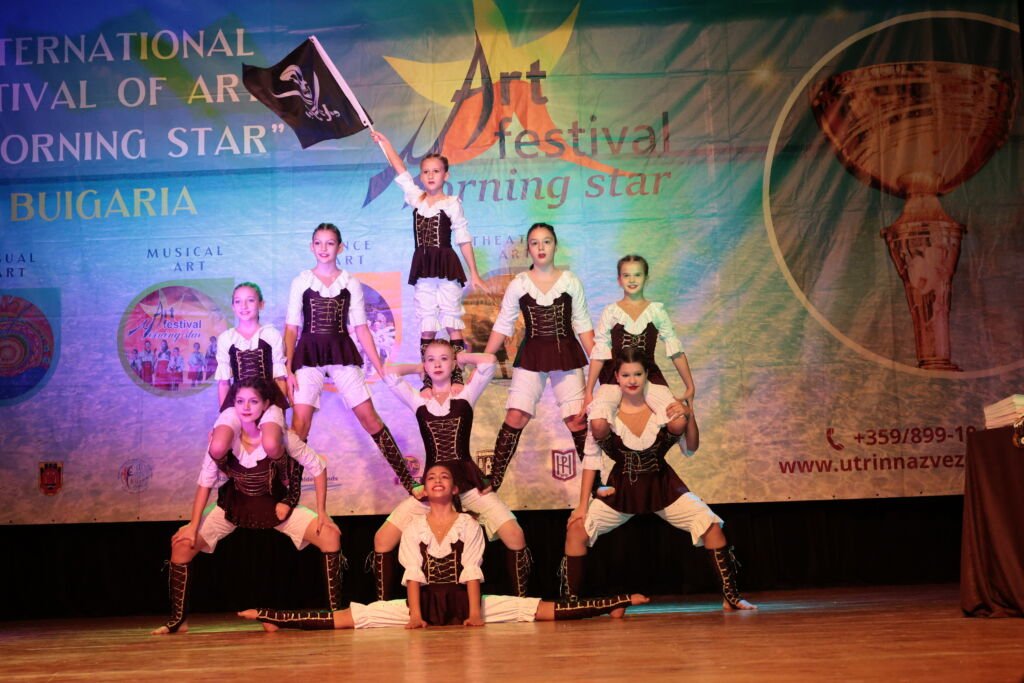
XLII International Festival of the Arts «MORNING STAR» Golden Sands 18-25.08.2026
ORGANIZERS:
Art Academy “Morning Star” Section of the International Dance Council /CID UNESCO/
Total prize fund 4500 BGN
GRAND PRIX 1200 BGN
We invite you to the International Festival of the Arts “Morning Star”, which is held in the most beautiful Bulgarian resorts – in summer at the seaside resorts Golden Sands, Sunny Beach, in winter in Bansko, in the city of Sofia, the city of Pernik, and it is one of the leading and prestigious festivals in Bulgaria! With each new edition it attracts thousands of participants and gains increasing popularity in the country and abroad!
Regulations
Objectives of the organizers:
- Providing an opportunity for talented children and adults to fully demonstrate their abilities
- Development of various types of arts and encouragement of children and youth towards activities related to the arts
- Exchange of creative experience
- Cooperation between leaders and friendship between groups
- Promoting world and national cultural values
Required documents to apply for participation:
- participation form / online application through the website
- payment document
- list of participants with dates of birth.
Participants in the competition:
The competition is open to everyone – individual participants, community cultural centers (chitalishta), children’s development centers, youth houses, academies, children’s palaces, private schools, studios, clubs, relaxation schools and others.
Age categories:
I. Category
| I. Category (MINI) | up to 8 years 4 months |
| II. Category | from 8 years 4 months to 12 years 4 months |
III. Category | from 12 years 4 months to 15 years 4 months |
IV. Category | 15 – 18 years |
| V. Category | 18 – 25 years |
| VI. Category | over 25 years |
| VII. Mixed | /for productions/ |
Participation format
- Solo
- Duet/Trio
- Small groups – 4-8 people
- Formations – over 8 people
- Production – over 20 people
DANCE ARTS SECTION
STYLES:
- CLASSICAL BALLET. NEOCLASSICAL
- CHARACTER DANCES. ETHNO SHOW. STYLIZED FOLKLORE
- SPORT AND SOCIAL DANCES
- DANCE SHOW
- OPEN
- JAZZ.
- CONTEMPORARY
- HIP HOP / STREET DANCE
- MTV / COMMERCIAL
- CHEERLEEDING
- RHYTHMIC GYMNASTICS
- ACRO DANCE
CLASSICAL BALLET. NEOCLASSICAL
*Pointe shoes are not approved for dancers in the MINI category.
*Use of scenery, accessories and supports is allowed.
In «classical choreography» compositions may be presented to classical music. They are performed in costumes traditional for the style. Shoes – demi-pointe, pointe shoes. Dancers in this category must perform classical choreography.
In “Neoclassical” compositions may be presented using classical, stylized classical or contemporary music. The basis of the choreography must be classical, but with original elements from other styles. Originality and stylization may be added to the costumes. It is possible to perform barefoot.
CHARACTER DANCES, FOLK-STYLIZED, ETHNO SHOW.
*The choreography must be created on the basis of authentic folk dances of the peoples.
This discipline includes the traditional dances of each nationality, passed down from generation to generation. The dances may be selected from any geographic or ethnic territory and may represent any historical period.
*The use of traditional costumes and music is mandatory.
*Folk-stylized dance – the choreography must correspond to the traditional dance, but contemporary dance techniques may be used. The costume must convey the characteristic image, but it may be simplified/stylized.
DANCE SHOW
*The dance must be narrative or narrative-image based, with an arrangement of choreographic material that creates a meaningful, emotional, or tempo build-up of the number. Accessories, decorations and stage material are allowed.
*The use of acrobatic elements is allowed, but it does not give an advantage.
*Dance lifts, strength and other elements are allowed.
Dance show is a complex, synthesized dance direction based on free combinations of elements of classical choreography, jazz, modern, contemporary choreography, folk stylization, variety, cabaret, acrobatic elements, etc. It is a musical-choreographic miniature with such an arrangement of the choreographic material that allows for revealing meaning and emotion in the number. The composition may be emotional and contain show elements. The basis of the dance must include a dramaturgical action that contains three compositional elements: introduction, climax and finale.
SOCIAL AND SPORT DANCES:
- Sport dances
- Latin show
- Salsa
- Bachata
- Merengue
- Rueda
- Argentine tango / Hustle
MODERN, JAZZ. CONTEMPORARY.
All dance movements must be in the respective technique. Typical positions of legs, arms and body for the style. Decorations and stage material are allowed; the use of accessories that are part of the costume or the dancer’s character is allowed.
All dance movements must be in the respective technique. Typical positions of legs, arms and body for the style. Decorations and stage material are allowed; the use of accessories that are part of the costume or the dancer’s character is allowed.
Jazz – combines in itself the folklore of African Americans and the dances of other immigrants. It is distinguished by freedom of movement of the body and its separate parts both horizontally and vertically. – coordinating movements with the rhythm of the music; – syncopation – rhythm between the strong beats of the music; – isolated movements – mobility of only one part of the body, while at the same time the whole body is still or moves in the opposite direction.
Contemporary – in the choreography of the dance there are elements of modern, jazz, folk dances, classical ballet with Eastern techniques and culture /yoga, elements of martial arts/. This style is constantly developing; it is work on the plasticity and grace of the body, stretching of all muscle groups, jumps, falls, slides across the floor, contact improvisation. A characteristic feature of contemporary is the alternation of tense muscles and unexpected relaxation of the body, sudden stopping, falling and rising, balancing. Contemporary contains elements of classical dance, but if classical is strict forms of expression and an exact script, then in contemporary it is important for the dancer to listen to the voice of their body, which expresses emotional experiences.
OPEN
In this category there is no restriction on dance styles. The styles used may be in pure form or combined. – Use of scenery and decorations is not allowed. Use of accessories that are part of the costume or the dancer’s character is allowed. Use of acrobatic elements is allowed, but it does not give an advantage.
STREET DANCE / HIP – HOP
Use of props is not recommended. Use of accessories is allowed – Use of acrobatic elements is allowed, but they must not be dominant. When submitting the application, the style must be indicated: STREET (Hip-Hop\Popping\Locking\House\Breaking), DANCEHALL (Dancehall,Twerk), FEMALE CHOREO (Vogue\Waacking\High Heels\ Jazz Funk \Go-Go\Pole Dance)
MTV Commercial
is a highly visual and energetic dance style created specifically for the entertainment industry—music videos, concerts, commercials, and television shows. The style is not strictly fixed; it combines elements of Hip-Hop, Jazz Funk, Street Jazz, and sometimes even Dancehall or Waacking, and it is oriented toward the audience and the camera. Stage presence, facial expressions (so-called “facials”), and camera awareness are essential. Choreography often follows not only the beat, but also the lyrics or specific sounds in the music. The movements are clean, sharp, and accentuated to look strong on screen. The style often emphasizes the dancer’s individuality, charisma, and confidence, frequently incorporating elements of provocation or high intensity.
MAJORETTE ENSEMBLES.
Parade and sport majorettes. – Use of scenery and decorations is not allowed. – Use of acrobatic elements is allowed. – Dance lifts, strength and other elements are allowed.
RHYTHMIC GYMNASTICS. ACRO DANCE.
Use of scenery and decorations is not allowed. – Use of acrobatic elements is allowed. – Dance lifts, strength and other elements are allowed.
*solo, duet and trio performances must not exceed 2 min. / groups and formations 8 min.
*incorrectly stated performance duration will be penalized by stopping the performance and deducting points!!!
* the music must be sent by e-mail – festival_utrinnazvezda@abv.bg The file must be RENAMED according to the template specified in the general terms item 7.
EVALUATION CRITERIA. DANCE ARTS SECTION
«INTERPRETATION» : the dancer’s ability to follow the rhythm and musicality of the melody and express them through body movement; the ability to use movements and technical elements adequately to the musical pattern; the dancer’s ability to smoothly continue the dance pattern after a “stop”, “pause” and other figures. “Interpretation” may also be understood as the dancer’s ability to adapt and fit movements to the music.
«TECHNIQUE»: the execution of movements must correspond to the music; performance of technical elements, movements and figures (position, precision, coordination, balance and body control); use of the entire space both individually and collectively in vertical, horizontal and diagonal planes; synchronization.
«CHOREOGRAPHY» : distribution of movements and figures in accordance with the dance context, costume and music. Suitability of the repertoire to the age of the performers.
«IMAGE» : acting skills, presentation of the dancers on stage. The performers’ ability to demonstrate emotions and feelings. Opening and closing presentation of the dancers.
Here’s the English translation, keeping the structure and meaning clear:
MUSIC SECTION
FOLK SINGING
VARIETY AND POP SONG
JAZZ, ROCK, R&B
INSTRUMENTAL PERFORMERS
(Soloists, Orchestras, Ensembles)
Performers present songs or instrumental compositions with a total duration of:
- Duration: up to 8 minutes per category (compositions or 2 songs)
- Individual and group performers: up to 2 songs
- Accompaniment: up to 5 accompanying musicians allowed
- Original (author’s) songs have priority
- Orchestras and bands: present 2 compositions
PARTICIPATION FORMAT
- Solo
- Duo / Trio
- Small groups (4–8 performers)
- Ensembles (more than 8 performers)
- Choir
EVALUATION CRITERIA
Intonation and Timbre
(For vocalists; for instrumentalists – technical performance precision)
- Accuracy of intonation
- Articulation and preservation of stylistic character
- Tempo appropriate to the musical piece
- Phrasing logically derived from musical development
- Dynamics consistent with the expressive development
- Metric and rhythmic stability
- Breathing and sound support (for singers and wind instrument performers)
Interpretation and Style
Repertoire Selection
(For ensembles, duos, and trios – performance of unison and polyphony, accurate intonation of choral parts, ensemble cohesion)
- Suitability of the repertoire to the performers’ technical and artistic abilities
Stage Presence and Artistry
THEATRE
Theatrical Performance
Recital – Solo / Duo / Trio
PERFORMANCE DURATION
- Theatrical performance: up to 40 minutes
- Recital: 5 minutes
EVALUATION CRITERIA
Theatrical Performance
- Artistic quality
- Directing
- Stage production
- Scenography
EVALUATION CRITERIA
Recital
Technique and Clarity
- Diction: Clear pronunciation, intelligibility
- Dynamics: Skillful variation between loud and soft speech
- Tempo: Appropriate rhythm and use of pauses
- Vocal qualities: Strength, tone, expressiveness
Interpretation
- Emotional expression: Conveying the emotions embedded in the text
- Artistry: Gestures, facial expressions, audience contact, overall stage presence
- Text comprehension: Demonstrating depth of understanding and interpretation
Content and Structure
- Repertoire selection: Relevance to the theme (if applicable) and originality
- Overall impact: Artistic value, attractiveness, and memorability of the performance
- Musical / stage design: Use of music, lighting, and set elements (if applicable)
Stage Behavior
VISUAL ARTS
Graphics / Painting
Short Film / Animation
Digital Works
- Participants present one film, artwork, or digital piece.
- Films, animations, and digital works will be presented to the jury during the competition.
- Artworks will be displayed in an exhibition during the Gala Concert.
- Paintings will be created during the festival; execution technique is free.
- The theme will be announced on-site.
- The organizers will provide painting surfaces (paper, canvas).
EVALUATION CRITERIA
- Composition
- Painting style
- Originality / depth of theme interpretation; cognitive and cultural components
- Emotional impact
- Directing and cinematography (shooting complexity, technical quality, editing artistry)
- Musical accompaniment
- Screenwriting
FOLKLORE-ETHNOGRAPHIC GENRE
Folklore-ethnographic groups present numbers and programs created on the basis of folklore, folk (regional, local) customs. Duration up to 8 min.
Age categories:
up to 20 years
over 20 years
ASSESSMENT CRITERIA:
quality of folklore material (artistic value, ethnographic accuracy);
correspondence of style and manner of performance, accompaniment, attributes, costumes to folk (regional, local) traditions; – quality of performance;
spectacular solution of performance, brightness and originality, originality of performance;
correspondence of costumes, musical instruments and props to the theme of performance;
CIRCUS ART
Acrobatics.
Juggling
Illusion genre
Original genre
Rubber
Clowning
Equilibristics
Gymnastics
Show program, etc.
JUDGING CRITERIA
Direction;
Originality;
Complexity of the trick, technique of execution;
Artistry, stage culture
PRIZE FUND:
Total prize fund of the “Morning Star” festival worth 8000 euros!!!
Special prizes are awarded in all competition sections!
“GRAND PRIX” – a check worth 500 euros.
SPECIAL PRIZES: vouchers for participation in the MFI “Morning Star” Golden Sands – 2027.
vouchers for participation in the MFI “Morning Star” Bansko – 2026.
The competition to determine the GRAND PRIX will consist of two parts:
On 29.06.26, only the collectives and groups determined by the jury members, based on their competition participation during the festival days, will participate in the Grand Prix Nomination Competition. The nominees will present one performance to the audience. Then the jury will determine the TOP 3.
- Voting: The audience will cast their vote for the Top 3
through Instagram voting on the morningstar.artfest profile. At the same time, each member of the jury casts their vote. Voting ends simultaneously for everyone and the points are determined according to the following principle:
Audience: First place – 6 points; 2nd place – 4 points; 3rd place – 2 points Jury: One point for each member of the jury.
The collective that has collected the most points after calculating the final result wins the Grand Prix.
We can’t wait to see you all there! We are waiting for you!
Art Academy Award “Morning Star” – laureates receive an invitation to represent Bulgaria at European and world competitions and festivals!
The awards are given at the discretion of the jury, organizers and partners of the competition. The right is reserved not to award any of the above-mentioned awards.
APPLICATION DEADLINE: 15.06.2026


